Friday, November 11, 2011
RiP: A Remix Manifesto
Rip: A Remix Manifesto was a very captivating film that was thought provoking and definitely made the viewer think. There were many points that were brought up throughout the film that I never considered and made me more aware of the consequences of copyright. I always knew that downloading music was illegal, but I wasn't aware that the punishment was so harsh. The band Girl Talk that was focused upon in the movie, uses mash up and combinations from other songs to recreate their own work. Even though they are using their own creativity, they still cross the lines of infringement and have broken the law. I personally think that the concept of Girl Talk's work is unique and interesting, in which it allows for altering and using their own mind to create something. Considering the law of fair use, material created from others can be used in moderation, but there are also strict guidelines to the usage. I think that this video was unique and creative in demonstrating the idea of fair use and copyright, in which it made it quite obvious the restrictions and laws. When you look deeper into the past, many works are merely created from previous works in history. Even though an artist may think that they are creating something new, there is always a chance that it's extremely similar to another artist's work, in which this could begin a lawsuit.

Wednesday, November 2, 2011
Appropriation Artists
Cindy Sherman. January 19. 1954. Glen Ridge, New Jersey. New York City. Buffalo State College. Photography. Untitled Film Still #96, Untitled #471, Untitled #223.
Yasumasa Morimura. June 11, 1951. Osaka, Japan. Japan. Kyoto City University of Arts. Photography. Self Portrait after Marilyn Monroe.
Samuel Fosso. 1962. Cameroon. Bangui, Central African Republic. Photography. Malcolm X, Muhammad Ali.
Yasumasa Morimura. June 11, 1951. Osaka, Japan. Japan. Kyoto City University of Arts. Photography. Self Portrait after Marilyn Monroe.
Samuel Fosso. 1962. Cameroon. Bangui, Central African Republic. Photography. Malcolm X, Muhammad Ali.
Monday, October 31, 2011
Artists
Arthur Fields. 1960’s. Texas. Brookhaven College, Washington University, Texas Women’s University. Photography, Social Networking Sites.
Banksy. Early 1970’s. Graffiti. Exit Through The Gift Shop.
Brody Condon. 1974, Mexico. Video, Editing Software. Velvet Strike. Twentyfivefoldmanifestation.
Monday, October 24, 2011
Final Broadcasting Project
For my final project on broadcasting, I decided to use Facebook as my vehicle. I had to consider just how I wanted to incorporate my message as an artist, as well as how this would coincide with my media broadcasting tool of Facebook. As an artist, I want my viewers to obtain the message that creativity is limitless. The idea behind this is that people may stent the limit of their creativity, but can be to ends length as long as the mind uses it correctly. Along with creativity, I began to think about the concept of self expression and personality because of the vehicle of Facebook. I've found that people often express themselves through social networking sites differently than they may actually be or say things that aren't necessarily their exact expression. There's almost a filter that is fronted once someone begins to write a post on their Facebook wall, whether it is the one minute of consideration to actually post something or how to post something to gain attention of their "friends." Facebook can display false self expressions of people, as well as a personality that can be altered to impress others.
So considering all of this, I wanted to create a piece that explained my ideas and thoughts about this site. I used several images of friends/family and created a work that included their image as well as a status from their page. I carefully chose each image and status in order for it to closely parallel my perspective and thoughts on the specific person. I'm close with all of the people that I used for the project and understand their personality quite well. For the first work, it displays images that are simple, posed, smiling and regular, along with a status that is out of the ordinary. My concept behind this explains that on the exterior the person may seem completely happy, problem free and confident, while the status may explain their true personality. For example, the first image is of my boyfriend Marshall, where he is smiling, and his status contains an obscure and unique statement. Considering the fact that I know him so well, this all makes complete sense to me, but for the viewer it may seem confusing. His self expression on Facebook is quite accurate with his personality, as well as his creativity. Even though this post was accurate, I'm certain that there have been other posts that he was unsure of or may have questioned whether or not it should be broadcasted to everyone.
To further my ideas on self expression, creativity and personality within Facebook, I created a second work. Within this piece, I chose to use the same people, but different images and different statuses. These pictures are either silly, unexpected or physically demonstrating their personality. The status incorporated with each image is more typical, whether it is about their day or the weather. The idea behind this set is that someones true personality may show on the outside, but in the inside it may be completely different. Creativity is often limited because people may be ashamed or nervous about their thoughts and are worried about what others may think. This is very true when it comes to Facebook because people may post different pictures and statuses but are secretly thinking about what others may think. Creativity is similar to Facebook because there is that idea of ambiguity and whether or not you actually know the real person and their limits, thoughts and ideas. I think that this project can clarify my viewpoints on Facebook as a networking site, as well as my personal opinions on the use.
So considering all of this, I wanted to create a piece that explained my ideas and thoughts about this site. I used several images of friends/family and created a work that included their image as well as a status from their page. I carefully chose each image and status in order for it to closely parallel my perspective and thoughts on the specific person. I'm close with all of the people that I used for the project and understand their personality quite well. For the first work, it displays images that are simple, posed, smiling and regular, along with a status that is out of the ordinary. My concept behind this explains that on the exterior the person may seem completely happy, problem free and confident, while the status may explain their true personality. For example, the first image is of my boyfriend Marshall, where he is smiling, and his status contains an obscure and unique statement. Considering the fact that I know him so well, this all makes complete sense to me, but for the viewer it may seem confusing. His self expression on Facebook is quite accurate with his personality, as well as his creativity. Even though this post was accurate, I'm certain that there have been other posts that he was unsure of or may have questioned whether or not it should be broadcasted to everyone.
To further my ideas on self expression, creativity and personality within Facebook, I created a second work. Within this piece, I chose to use the same people, but different images and different statuses. These pictures are either silly, unexpected or physically demonstrating their personality. The status incorporated with each image is more typical, whether it is about their day or the weather. The idea behind this set is that someones true personality may show on the outside, but in the inside it may be completely different. Creativity is often limited because people may be ashamed or nervous about their thoughts and are worried about what others may think. This is very true when it comes to Facebook because people may post different pictures and statuses but are secretly thinking about what others may think. Creativity is similar to Facebook because there is that idea of ambiguity and whether or not you actually know the real person and their limits, thoughts and ideas. I think that this project can clarify my viewpoints on Facebook as a networking site, as well as my personal opinions on the use.
Thursday, October 13, 2011
New Project Proposal
After researching and looking more in depth with the broadcasting artist, Arthur Fields; I gained many new insights and ideas to my next project. To further incorporate the concept of broadcasting and Facebook as the vehicle, I've thought about using peoples actual Facebook profile pictures. In a specific work with Arthur Fields, he created a piece that uses all 600 of his Facebook friends and displays all of their profile pictures. I wanted to include my original message of creativity and how it's ultimately limitless. To incorporate my Facebook idea with creativity, I'm going to use the concept of identity.
From the ideas of Arthur Fields, I'd like to use profile pictures of my friends and use that with my broadcasting piece. My final thoughts on this project would be to make two different panoramic size canvases and include several profile pictures. With the first panel of identity, i'd blur the profile image to where it's difficult, if not nearly impossible to distinguish who the person is in the picture. With the second panel of creativity, i'd also use profile pictures but use several different effects and filters to make the images hard to distinguish. The main concept behind my project would be that there is often a gray area between people's self identity, which can ultimately affect ones ability to be creative. Along with using peoples profile pictures, to further the idea as Facebook being my vehicle, I'm going to use status updates as well. I think that it would be interesting to choose a status that focuses on a specific person's creativity and advance with that idea. I could still include the profile picture, but also overlay the status and connect that with my message of creativity and identity. In order to present this material, I would create several of these image and status combinations to create a collection of works that would be displayed on Facebook. When each different image and status is posted, I could also include a "quote of the day" that would discuss my overall concept of creativity.
From the ideas of Arthur Fields, I'd like to use profile pictures of my friends and use that with my broadcasting piece. My final thoughts on this project would be to make two different panoramic size canvases and include several profile pictures. With the first panel of identity, i'd blur the profile image to where it's difficult, if not nearly impossible to distinguish who the person is in the picture. With the second panel of creativity, i'd also use profile pictures but use several different effects and filters to make the images hard to distinguish. The main concept behind my project would be that there is often a gray area between people's self identity, which can ultimately affect ones ability to be creative. Along with using peoples profile pictures, to further the idea as Facebook being my vehicle, I'm going to use status updates as well. I think that it would be interesting to choose a status that focuses on a specific person's creativity and advance with that idea. I could still include the profile picture, but also overlay the status and connect that with my message of creativity and identity. In order to present this material, I would create several of these image and status combinations to create a collection of works that would be displayed on Facebook. When each different image and status is posted, I could also include a "quote of the day" that would discuss my overall concept of creativity.
Tuesday, October 11, 2011
Arthur Fields
Arthur Fields uses the medium of photography to create his art. The use of cell phones is how his work is created and is the bulk of his portfolio.
Fields posts daily cell phone pics in his blog/tumblr, whether it is a shadow of a sign or a deer head on the wall. He seems to capture the simple things in life, but are aesthetically pleasing. Along with the cell phone picture, he includes different quotes about photography from well known people.
One of his most recent exhibitions Techincally Connected focuses on social network users and reveals their identities and behaviors. Digital photography and appropriated images are used to demonstrate personal relationships with friends and family through people who are cell phone users.


I grew up in the 70's.
I really enjoyed the 80's.
I use my cell phone as a sketchbook
These are daily observations by me.
They are fun and free.
Images are all mine unless otherwise noted.
Remember Photo Art makes you happy!"
Arthur Fields
http://arthurfields.tumblr.com/
http://arthurfields.tumblr.com/archive
http://arthurfieldsphoto.com/home.html
http://www.arthurfields.com/ArthurFields/h_o_m_e.html
http://www.arthurfields.com/ArthurFields/g_a_l_l_e_r_i_e_s/Pages/t_e_c_h_n_i_c_a_l_l_y_c_o_n_n_e_c_t_e_d.html
Fields posts daily cell phone pics in his blog/tumblr, whether it is a shadow of a sign or a deer head on the wall. He seems to capture the simple things in life, but are aesthetically pleasing. Along with the cell phone picture, he includes different quotes about photography from well known people.
One of his most recent exhibitions Techincally Connected focuses on social network users and reveals their identities and behaviors. Digital photography and appropriated images are used to demonstrate personal relationships with friends and family through people who are cell phone users.


"I am a Texan.
I was born in the 60's. I grew up in the 70's.
I really enjoyed the 80's.
I use my cell phone as a sketchbook
These are daily observations by me.
They are fun and free.
Images are all mine unless otherwise noted.
Remember Photo Art makes you happy!"
Arthur Fields
http://arthurfields.tumblr.com/
http://arthurfields.tumblr.com/archive
http://arthurfieldsphoto.com/home.html
http://www.arthurfields.com/ArthurFields/h_o_m_e.html
http://www.arthurfields.com/ArthurFields/g_a_l_l_e_r_i_e_s/Pages/t_e_c_h_n_i_c_a_l_l_y_c_o_n_n_e_c_t_e_d.html
Thursday, October 6, 2011
Project Proposal
Title: Flowing Creativity
For my next project, I had the idea to use the concept of creativity as my basis. I think that creativity is often a term that people don't completely understand, especially when it comes to art. There are so many different aspects of creativity that will overall produce a final piece of work. When thinking about this term as a whole, there are several key elements to take into consideration. Everyone's mind set and ideas will differ, but it's the specifics that will separate one from another. Color use, shape, medium, overall concept, steps for completion, planning and execution are just a few that creativity will enthrall upon.
My idea for the project is to create a collection of four different posters that will demonstrate creativity visually. I'm debating about using a similar format within each of the posters, but also demonstrate how the creative mind can overtake parameters. Ultimately I want to express that there are no limitations when creating art. I'm going to use a computer program; most likely photoshop, along with used photographs, color and text. I will broadcast this on Facebook to see what my friends and peers think. I think that it will be interesting to see the responses from others and to gain an understanding of how their creativity and mindset may differ from mine. The works that I create will have the words creativity throughout the piece, which will help viewers gain an understanding. I'm also thinking about leaving a caption on the piece that I post, asking which one the viewers like the most. This will not only allow me to see what others creativity is like, but also touch more upon the broadcasting aspect of the project.
For my next project, I had the idea to use the concept of creativity as my basis. I think that creativity is often a term that people don't completely understand, especially when it comes to art. There are so many different aspects of creativity that will overall produce a final piece of work. When thinking about this term as a whole, there are several key elements to take into consideration. Everyone's mind set and ideas will differ, but it's the specifics that will separate one from another. Color use, shape, medium, overall concept, steps for completion, planning and execution are just a few that creativity will enthrall upon.
My idea for the project is to create a collection of four different posters that will demonstrate creativity visually. I'm debating about using a similar format within each of the posters, but also demonstrate how the creative mind can overtake parameters. Ultimately I want to express that there are no limitations when creating art. I'm going to use a computer program; most likely photoshop, along with used photographs, color and text. I will broadcast this on Facebook to see what my friends and peers think. I think that it will be interesting to see the responses from others and to gain an understanding of how their creativity and mindset may differ from mine. The works that I create will have the words creativity throughout the piece, which will help viewers gain an understanding. I'm also thinking about leaving a caption on the piece that I post, asking which one the viewers like the most. This will not only allow me to see what others creativity is like, but also touch more upon the broadcasting aspect of the project.
Tuesday, October 4, 2011
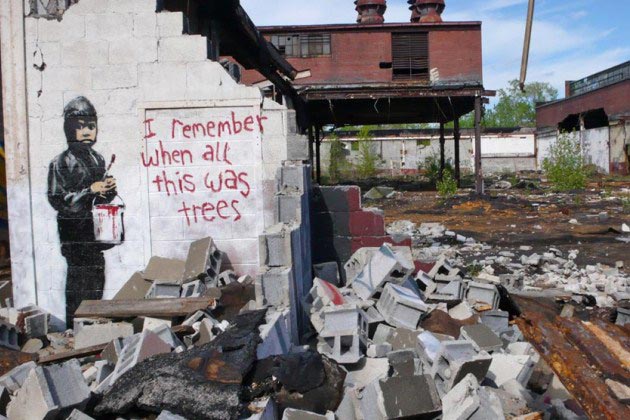
Banksy
Born in the early 1970's, specific date is unknown.
England based graffiti artist that also has a strong concentration on politics, film and painting.
Banksy's art can be viewed throughout the world, whether it be on walls or streets in many different large cities.
The medium or vehicle used by Banksy would be paint and stencils. Location is also a key factor to how his piece will be portrayed.
He wants all of society to view his work and wants everyone to be educated by the political and social themes that he presents. Some of his most commonly displayed issues are anti-war, anti-capitalism and anti-facisim. He also wants to gain attention of those who are unaware of societal issues.
Many of his works include policemen, elderly, and children to demonstrate other societal issues such as, poverty, boredom and hypocrisy.
Exit Through The Gift Shop was a film that was supposedly about Banksy. He created 10 new works that would be incorporated within this film. There were several pieces created around the Detroit area, in which one was located in Royal Oak and the other in Warren.
"We can’t do anything to change the world until capitalism crumbles. In the meantime we should all go shopping to console ourselves."
"Sometimes I feel so sick at the state of the world, I can’t even finish my second apple pie."


England based graffiti artist that also has a strong concentration on politics, film and painting.
Banksy's art can be viewed throughout the world, whether it be on walls or streets in many different large cities.
The medium or vehicle used by Banksy would be paint and stencils. Location is also a key factor to how his piece will be portrayed.
He wants all of society to view his work and wants everyone to be educated by the political and social themes that he presents. Some of his most commonly displayed issues are anti-war, anti-capitalism and anti-facisim. He also wants to gain attention of those who are unaware of societal issues.
Many of his works include policemen, elderly, and children to demonstrate other societal issues such as, poverty, boredom and hypocrisy.
Exit Through The Gift Shop was a film that was supposedly about Banksy. He created 10 new works that would be incorporated within this film. There were several pieces created around the Detroit area, in which one was located in Royal Oak and the other in Warren.
"We can’t do anything to change the world until capitalism crumbles. In the meantime we should all go shopping to console ourselves."
"Sometimes I feel so sick at the state of the world, I can’t even finish my second apple pie."

Wednesday, September 28, 2011
Broadcasting Artists
Nam June Paik
Adam Hyde and Honor Harger
http://en.wikipedia.org/wiki/Radioqualia
Yasunao Tone and Tetsuo Kogawa
http://rwm.macba.cat/en/curatorial?id_capsula=464
Adam Hyde and Honor Harger
http://en.wikipedia.org/wiki/Radioqualia
Yasunao Tone and Tetsuo Kogawa
http://rwm.macba.cat/en/curatorial?id_capsula=464
Sunday, September 25, 2011
Importance of Game Creation
When creating my game there were many key factors that were important to take into account for the final product. One of the most important things to think about was the overall meaning and object of the game. I wanted to focus on what my classmates satisfaction would be and what they could ultimately take away from playing my game. I know personally that I enjoy gaining something after playing a game, whether it be satisfaction of victory, having a good time or learning something new. I also wanted to make sure while creating this game that it had a meaningful purpose and that the ideas were well developed. I find it often frustrating when playing a game and the object, rules and concept is unclear. This is a very important factor because I wanted my game to be something rewarding rather than confusing and stressful.
Another important factor when creating my game was the overall idea of strategy and social interaction within game play. When playing a game, you more than likely want a challenge, as well as options. My game allowed for each player to display and share their own addition to the story. This demonstrated a sense of determining a strategy for each player and also for the gamemaster to plan the path of the entire game. I also think that in certain games, social interaction is important to gain success. While creating my game, social interaction would've been via text message, but would have been vital in order for the game to work properly. A majority of games allow players to socialize with peers and friends, which can also make the experience of playing more pleasurable.
I'd have to say the most important thing while creating my game is the feeling of self success. If I were to work extensively on this game and would have to further elaborated upon it, I'd think that how it turned out to me personally would be important. Granted, I want the players to have a good time playing the game, I think that during creation, it's very important whether or not it would be successful in my mind. There are many important aspects to consider when creating a game, but many factors such as overall player and creator satisfaction would be universal for my game or nearly any other.
Another important factor when creating my game was the overall idea of strategy and social interaction within game play. When playing a game, you more than likely want a challenge, as well as options. My game allowed for each player to display and share their own addition to the story. This demonstrated a sense of determining a strategy for each player and also for the gamemaster to plan the path of the entire game. I also think that in certain games, social interaction is important to gain success. While creating my game, social interaction would've been via text message, but would have been vital in order for the game to work properly. A majority of games allow players to socialize with peers and friends, which can also make the experience of playing more pleasurable.
I'd have to say the most important thing while creating my game is the feeling of self success. If I were to work extensively on this game and would have to further elaborated upon it, I'd think that how it turned out to me personally would be important. Granted, I want the players to have a good time playing the game, I think that during creation, it's very important whether or not it would be successful in my mind. There are many important aspects to consider when creating a game, but many factors such as overall player and creator satisfaction would be universal for my game or nearly any other.
Sunday, September 18, 2011
Video Game Project Discussion
The creation of the video game project is both similar and dissimilar to making an artwork in many different aspects. While coming up with the initial idea and concept behind my video game, I had to physically write my ideas down and brainstorm the entire creation. There were many key factors that were important to think about while creating this game, such as rules, object, meaning, purpose and how this would become successful within our class. When creating a work of art, there is a similar process that I follow before each piece that I work on. I sketch out my ideas on paper or on the computer, which allows me to visually demonstrate what the final concept will be. I also take into consideration the meaning of the piece, as well as the object, in which how it will affect the audience and viewers. During the creation process of the video game project, I had to look at the fine details and decide which were important and which were unnecessary. This is also similar to the creation of an artwork because I have to make decisions of what looks right and when it's time to stop. For instance, while working on an edited photograph, I have to decide when I've done enough or what else I can do to further elaborate my ideas successfully.
The overall design steps and early planning are quite similar between the video game project and the creation of an artwork, but there are also dissimilarities. While creating the video game, the thoughts of the players, location and physical actions are important. Compared to the process of an artwork they aren't as often thought about. I also found myself constantly changing my mind on different aspects and making alterations as discussion was further made. Whether the change be where the game took place or the set of rules, neither applies to when I create artwork. When making artwork, I feel a sense of freedom and exploration to visually apply these feelings on paper or digitally. This is dissimilar to the video game process where I felt restrictions and limitations even though I was the creator. I wanted to make sure that I considered the fact that my game wasn't going to be similar to any other previous game and I also wanted it to be something that my classmates would enjoy. I feel that when creating the video game, it was especially important that the peers would gain interest and have a positive experience while playing. When making a work of art, I think that there is more of a sense of self enjoyment and gaining a positive experience within to gain the feeling of achievement.
The overall design steps and early planning are quite similar between the video game project and the creation of an artwork, but there are also dissimilarities. While creating the video game, the thoughts of the players, location and physical actions are important. Compared to the process of an artwork they aren't as often thought about. I also found myself constantly changing my mind on different aspects and making alterations as discussion was further made. Whether the change be where the game took place or the set of rules, neither applies to when I create artwork. When making artwork, I feel a sense of freedom and exploration to visually apply these feelings on paper or digitally. This is dissimilar to the video game process where I felt restrictions and limitations even though I was the creator. I wanted to make sure that I considered the fact that my game wasn't going to be similar to any other previous game and I also wanted it to be something that my classmates would enjoy. I feel that when creating the video game, it was especially important that the peers would gain interest and have a positive experience while playing. When making a work of art, I think that there is more of a sense of self enjoyment and gaining a positive experience within to gain the feeling of achievement.
Tuesday, September 13, 2011
Advancement to Cell Phone Game
A new collaborated idea for my cell phone game is to not only assign numbers to each players, but also character roles. The concept of character roles will model more of the game line of actual LARPing. The characters will be any where from drunken townspeople to the mayor of the city. Depending on the character, the decisions and responses to previous texts will be based upon their stereotypical personality.
Brody Condon-LARP
LARP is a role playing game that allows players to create a character that will evolve. Each person assumes a role and continues their journey on the path that they choose. There are goals created within a fictional setting that are lead by a story teller, leader or gamemaster. The gamemaster is the one who determines the rules and setting of the game, as well as acts as the referee while the event takes place.
"During a LARP, player actions in the real world represent character actions in an imaginary setting. Game rules, physical symbols and theatrical improvisation are used to bridge differences between the real world and the setting. For example, a rope could signify an imaginary wall. Realistic-looking weapon props and risky physical activity are sometimes discouraged or forbidden for safety reasons" (Wikipedia).
There are game rules within LARPs, but typically the rules are determined by the gamemaster. The rules discuss character capability, allowance of objects within settings and determination of outcomes to particular actions. Also stated within Wikipedia, there are LARPs that don't use rules, but rather rely on players to decide outcomes and use their own previous knowledge to make judgement.
There are different variations and styles of LARP events, such as theater-style. Theater-style LARP is described as an organized event that takes place within a particular decorated room. The gamemaster will also define the rules, but weapons and fighting aren't necessarily used. The scenarios are more realistic, in which there are certain settings similar to murder mystery games.
Connection with Cell Phone Project:
The use of cell phones in a typical game of LARP wouldn't be necessary, but there are different parameters that could be used to create a similar approach to the game. There would be a gamemaster assigned before game play, in which they would determine rules, settings, story line, concepts and characters. The gamemaster would ultimately have the whole game and outcome planned.
Each of the different characters or players would receive a text from the gamemaster that would inform them the storyline, as well as give them guidance. All of the players will also be put into order and will have to remember which number they are. The texts will all be sent to every player, in which this will allow them to follow the story and continue their personal ideas. The first text will begin the story and give each player a description of the games purpose and goal. The second text will be sent to player number 1, which will then be time for response of that particular player. They will add on to the story and continue it's path in the direction that they choose. The following third, fourth, fifth text and so on, will also do the same, in which that particular player will continue the story from their point of view. This allows imagination to be demonstrated and freedom for players to choose their own path and journey.
At the end, when each player has added their portion to the story, there will be a final collaborative narrative.
Hirsch, Faye. Art in America. 5 October, 2010.
http://www.artinamericamagazine.com/features/brody-condon/2/
http://en.wikipedia.org/wiki/Live_action_role-playing_game
"During a LARP, player actions in the real world represent character actions in an imaginary setting. Game rules, physical symbols and theatrical improvisation are used to bridge differences between the real world and the setting. For example, a rope could signify an imaginary wall. Realistic-looking weapon props and risky physical activity are sometimes discouraged or forbidden for safety reasons" (Wikipedia).
There are game rules within LARPs, but typically the rules are determined by the gamemaster. The rules discuss character capability, allowance of objects within settings and determination of outcomes to particular actions. Also stated within Wikipedia, there are LARPs that don't use rules, but rather rely on players to decide outcomes and use their own previous knowledge to make judgement.
There are different variations and styles of LARP events, such as theater-style. Theater-style LARP is described as an organized event that takes place within a particular decorated room. The gamemaster will also define the rules, but weapons and fighting aren't necessarily used. The scenarios are more realistic, in which there are certain settings similar to murder mystery games.
Connection with Cell Phone Project:
The use of cell phones in a typical game of LARP wouldn't be necessary, but there are different parameters that could be used to create a similar approach to the game. There would be a gamemaster assigned before game play, in which they would determine rules, settings, story line, concepts and characters. The gamemaster would ultimately have the whole game and outcome planned.
Each of the different characters or players would receive a text from the gamemaster that would inform them the storyline, as well as give them guidance. All of the players will also be put into order and will have to remember which number they are. The texts will all be sent to every player, in which this will allow them to follow the story and continue their personal ideas. The first text will begin the story and give each player a description of the games purpose and goal. The second text will be sent to player number 1, which will then be time for response of that particular player. They will add on to the story and continue it's path in the direction that they choose. The following third, fourth, fifth text and so on, will also do the same, in which that particular player will continue the story from their point of view. This allows imagination to be demonstrated and freedom for players to choose their own path and journey.
At the end, when each player has added their portion to the story, there will be a final collaborative narrative.
Hirsch, Faye. Art in America. 5 October, 2010.
http://www.artinamericamagazine.com/features/brody-condon/2/
http://en.wikipedia.org/wiki/Live_action_role-playing_game
Wednesday, September 7, 2011
Brody Condon
Brody Condon was born in 1974, in Mexico. His main field of study and works are within the visual and media arts. Condon had an early interest in video games after receiving his education from UC San Diego. He often worked with collaborators and modified games, whether they were new concepts or similar to previous games. Some of the ideas were borrowed from other games such as Counter-Strike, which is a first person shooter computer game. One of his first works collaborated with Anne-Marie Schleiner and Joan Leandre, Velvet-Strike, was similar to the concept of the earlier game Counter-Strike. Within this game, players are given different spray paints to graffiti all around the entire play area. The concept behind this game was to further advance the thoughts of fantasy and steer away from the violence of terrorism and war. Condon and the other collaborators felt strongly that there needs to be more imagination within the environments and characters that are used in games.
Condon also organized a large performance called TwentyFiveFoldManfestation. This is a work of art that is considered live action role playing, in which 80 players were involved in the game. It creates a world of medieval fantasy and allows players to use fake weapons, along with their creative minds to make the story come to life.

http://www.opensorcery.net/velvet-strike/screenshots.html
http://www.youtube.com/watch?v=7s7P8pOGJbM&feature=player_embedded
Condon also organized a large performance called TwentyFiveFoldManfestation. This is a work of art that is considered live action role playing, in which 80 players were involved in the game. It creates a world of medieval fantasy and allows players to use fake weapons, along with their creative minds to make the story come to life.

http://www.opensorcery.net/velvet-strike/screenshots.html
http://www.youtube.com/watch?v=7s7P8pOGJbM&feature=player_embedded
Subscribe to:
Posts (Atom)